
Social Commerce Revolution: How Social Media Became Retail's Future
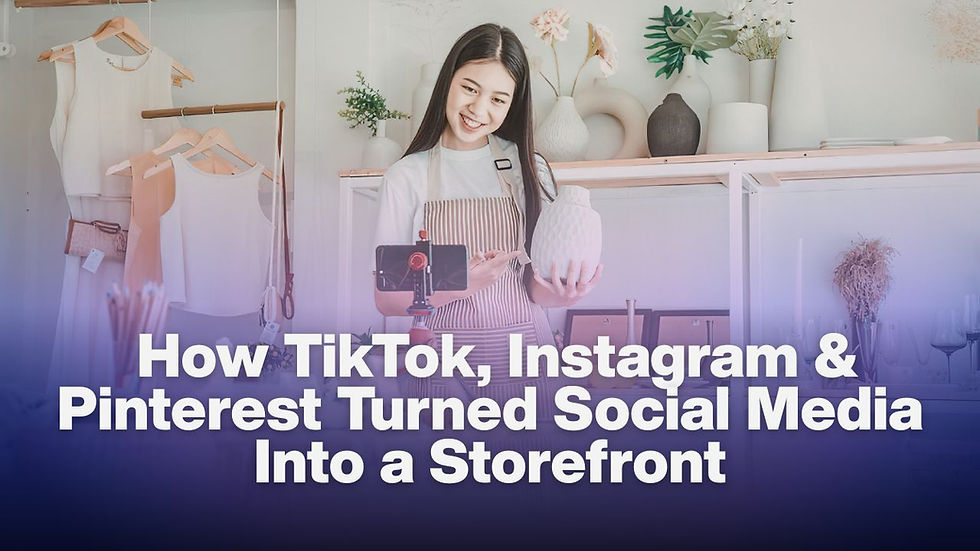
There's a moment that happened to millions of shoppers over the past few years — you're scrolling through your phone, half-asleep on the couch, and a video catches your eye. A skincare product. A pair of sneakers. A kitchen gadget you didn't know you needed. You tap once. Maybe twice. And suddenly, without ever leaving the app, you've bought something.
That's social commerce in action. And for brands paying attention, it's one of the most exciting shifts in retail in a generation.
Social platforms are no longer just places to build awareness or run ads that redirect people somewhere else. TikTok, Instagram, and Pinterest have quietly become full-blown storefronts — and the brands figuring out how to sell natively on these platforms are winning in ways that traditional e-commerce can't easily replicate. If you're still thinking about what the future of retail actually looks like, this breakdown of Amazon's big-box bet is a fascinating place to start, because the same tension between digital convenience and physical experience is driving social commerce forward too.
TikTok Shop: Where Impulse Buying Meets Entertainment
If Instagram made shopping aspirational, TikTok made it impulsive — in the best possible way.
TikTok Shop launched in the U.S. in late 2023 and immediately disrupted expectations. The platform's genius is that the purchase doesn't interrupt the entertainment. A creator is showing you how they make pasta, and the olive oil they're using is tagged right there in the video. You don't need to go hunt it down. You tap, you buy, you go back to watching pasta get made.
What's working for brands on TikTok Shop comes down to a few things.
Authenticity over polish. TikTok's algorithm rewards content that feels real, not produced. Brands that hand over creative control to creators — micro-influencers especially — tend to outperform polished brand-made content. A 22-year-old showing a product they genuinely love in their cluttered apartment will outsell a perfectly lit studio shoot almost every time.
Live shopping. This is the feature that most Western brands still haven't fully explored, even though it's been enormous in Asian markets for years. TikTok Live Shopping lets brands and creators sell in real-time, interacting with viewers, answering questions, and creating urgency. Brands that run consistent live shopping sessions — not just one-offs — report dramatically higher conversion rates than passive video content.
Affiliate programs with creators. TikTok's creator affiliate model lets brands set commission rates and let the creator ecosystem do the work of distribution. Instead of managing a handful of influencer partnerships, brands can have thousands of creators organically promoting their products and only pay when it converts.
The brands winning on TikTok Shop tend to be in categories with strong visual and demonstrable appeal: beauty, fashion, food, home goods, wellness. If your product looks good in action and solves a visible problem, TikTok is where you want to be. And if you're thinking about how big-budget marketing still fits into this creator-driven landscape, Super Bowl 2026 proved that brand investment at scale still has a place — the lesson isn't to abandon brand building, but to pair it with platforms where conversion happens naturally.
Instagram Shopping: The Polished Storefront
Instagram was social commerce before social commerce had a name. The platform has been building its shopping infrastructure for years, and today it offers one of the most seamless paths from discovery to purchase available anywhere.
Instagram Shopping — with its product tags, the Shop tab, shoppable Reels, and in-app checkout — has turned the platform into something closer to a visual catalog than a social network. And that's exactly why it works.
Shoppable content at every touchpoint. The best Instagram shopping strategies don't treat posts and stories as separate from the store. They treat every piece of content as a potential entry point. A product tagged in a Reel. A "swipe up" in a story. A collection curated by a creator. The more touchpoints a brand creates, the more chances someone has to convert.
Curated collections and editorial aesthetics. Unlike TikTok, Instagram still rewards a certain visual coherence. Brands that invest in a consistent aesthetic — not stuffy or over-designed, but intentional — build trust faster. When someone lands on your shop and everything looks like it belongs together, that's a subtle but powerful signal that you're a serious brand worth buying from. This overlaps directly with the broader logic of experiential and omnichannel retail: your digital shelf needs to feel like a place worth spending time in, not just a product dump.
Creator partnerships with product tags. Instagram's collaboration features and branded content tools let brands co-author posts with creators, meaning the post lives on both the creator's feed and the brand's. When those posts are shoppable, the reach doubles without the audience feeling like they're being advertised to.
Instagram's role in the discovery funnel. Something worth noting: Instagram Shopping often functions less as a point of first awareness and more as a place where consideration turns into conversion. Someone hears about a brand on TikTok, searches Instagram to see what the brand's world looks like, and buys there. Smart brands think about Instagram not in isolation but as part of a multi-platform journey. That omnichannel thinking — digital discovery feeding native purchase — is exactly what retail media strategists are mapping right now.
Pinterest: The Sleeper That Keeps Delivering
Pinterest doesn't get the breathless press coverage that TikTok does. It's not as culturally dominant as Instagram. But ask any brand in home décor, fashion, food, or wedding planning, and they'll tell you: Pinterest converts like nothing else.
The reason is intent. People come to Pinterest with a project in mind. They're planning a kitchen renovation, building a capsule wardrobe, or figuring out what to cook for the holidays. They're not passively scrolling — they're actively looking for inspiration and ideas. That intent changes everything about how shopping works on the platform.
Buyable Pins and product catalogs. Pinterest's shopping tools let brands connect their product catalog directly so that every product pin becomes a shoppable item with up-to-date pricing and inventory. The friction between inspiration and purchase collapses almost entirely.
SEO on Pinterest is massively underrated. Pinterest functions as a search engine as much as it does a social platform. People search for "small bathroom tile ideas" or "summer wedding guest outfit" the same way they'd search on Google. Brands that optimize their pin descriptions with real search terms — not just hashtags but actual descriptive language — get discovery that compounds over time. A well-optimized pin can drive traffic for years.
The long shelf life of content. On TikTok, a video is hot for a day or a week. On Pinterest, a pin can be re-saved and circulate for years. The compounding nature of Pinterest content means that early investment pays dividends long after you've stopped actively promoting a piece. For smaller brands especially, this is the kind of sustainable growth engine that makes a real difference — and it connects directly to the fundamentals of scaling a small business without burning through ad budget.
Idea Pins for deeper engagement. Pinterest's multi-page format allows brands to tell a fuller story — a recipe with a product, a room styled with a mood, a how-to that genuinely teaches something. Brands that create Idea Pins with real utility, not just product showcases, see much stronger saves and follows.
Principles That Cross Every Platform
There are a few things that successful social commerce brands do regardless of which platform they're on.
The first is that they stop thinking about social platforms as advertising channels and start thinking about them as stores with culture. You wouldn't open a retail space and fill it only with price tags. You'd create an environment, a feeling, a reason to stay and explore. The same logic applies here — and it's part of the same shift pushing physical retail toward experience-first design.
The second is that they meet people where the purchase makes sense. On TikTok, that means low-friction checkout during a moment of entertainment-driven impulse. On Instagram, it means visual trust-building with seamless checkout. On Pinterest, it means catching someone at exactly the moment they're planning something and being the answer to a specific question.
The third — and maybe most important — is that they invest in creators as a distribution channel, not just a marketing one. The brands generating the most social commerce revenue aren't running the best campaigns. They're building the best creator ecosystems. They find people who genuinely love their products, give them tools and incentives to share, and let the network do what networks do best. For brands looking to build those kinds of relationships at scale, Asia's B2B networking event landscape is increasingly where the right conversations are happening — connecting commerce leaders, retail innovators, and platform specialists in rooms designed for exactly this kind of thinking.
The Shift Is Already Happening
Social commerce is forecast to reach hundreds of billions of dollars globally in the next few years, according to Statista's social commerce revenue projections, and the gap between brands that have figured this out and brands still treating social as a brand-awareness play is only going to widen.
The good news is that the entry point isn't complicated. It starts with understanding where your customers actually spend their time, what kind of content earns their attention on those platforms, and how to remove every possible obstacle between "I want this" and "I bought it."
The platforms have done most of the infrastructure work. The brands that win from here will be the ones that show up with the right content, the right creators, and a genuine willingness to sell — not just to be seen.
For a broader look at where retail is heading — from social storefronts to omnichannel experiences — explore the Retail & E-Commerce coverage on rockbird media and the Marketing insights hub for the strategies shaping how brands connect, convert, and grow across every channel.
Social commerce is evolving fast. The brands building habits now, testing what works on each platform, and investing in creator relationships will be the ones who look back in five years and recognize this period as when everything changed.
Ready to Go Deeper? Join retailX Kuala Lumpur 2026
If everything in this article resonates with where your business is heading, there's one event in Southeast Asia this March that puts all of it in the same room.
retailX Kuala Lumpur 2026 is a one-day executive conference on March 26 at Aloft KL Sentral, Malaysia — built specifically for C-level and VP-level leaders in e-commerce, omnichannel, digital marketing, customer engagement, and mobile commerce.
This isn't a conference where you sit through presentations and collect business cards. It's structured around peer-to-peer roundtable discussions, closed-door 1:1 meetings, and fireside chats with practitioners who are navigating the same landscape you are — from customer retention in an oversaturated market to Malaysia's fast-evolving retail digital infrastructure.
What makes it worth the trip: retailX is co-located with dataAIX KL 2026, which means you get proximity to parallel conversations on AI, data strategy, and digital commerce — all in a single day, without splitting your calendar.
Malaysia's e-commerce market is projected to reach USD 15.7 billion by 2028. The people steering that growth will be in that room. Delegate passes start at $375.


Comments