
Nvidia's Water-Saving Data Center Cooling Tech Won't Fix AI's Real Water Problem
Why business leaders investing in AI infrastructure across Asia Pacific need to look past the data center walls
Nvidia's Water-Saving Data Center
Nvidia made a bold claim this month: its new warm-water liquid cooling system can eliminate “pretty much all water usage” inside a data center. For an industry under growing pressure over its environmental footprint, that headline sounds like good news. But for business and technology leaders building AI strategy in Asia Pacific, where data center growth is colliding with water-stressed cities and tightening regulation, the real story is more complicated.
Nvidia's cooling breakthrough only solves the water problem that happens inside the data center. The much larger water footprint, tied to how the electricity powering that data center is generated, remains untouched. For leaders evaluating AI vendors, data center partners, or sustainability commitments tied to AI adoption, understanding that distinction matters.
What Nvidia Actually Announced
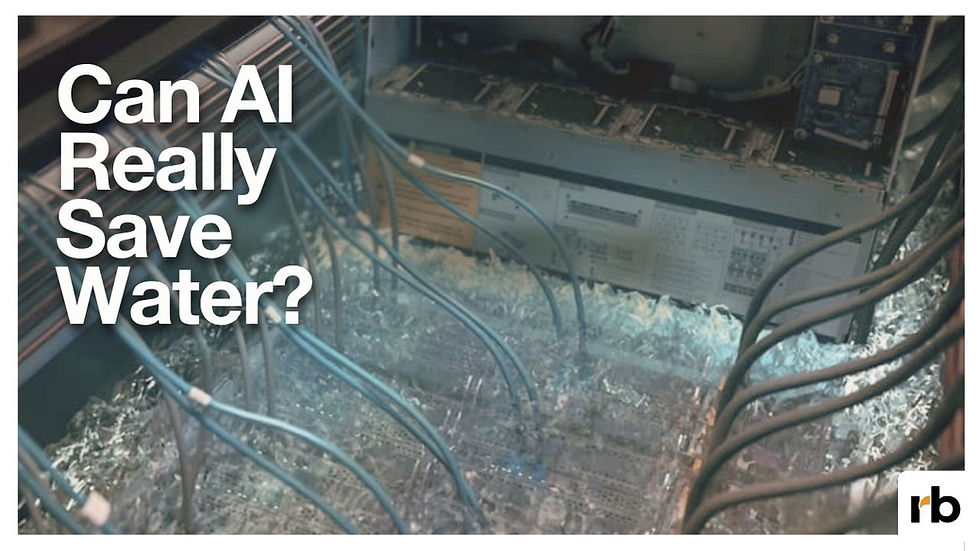
Nvidia's new system pumps coolant into server racks at 45°C, hot to the touch but well within range for computer chips. As the coolant passes through the hardware, it absorbs heat and exits at roughly 55°C. At that temperature, outside air in most climates can pull the heat away through passive radiators, often without fans or evaporative cooling towers. Because the coolant runs in a closed loop, filled once and recirculated for the life of the facility, Nvidia says some data centers could see a 100% reduction in on-site water consumption.
That is a genuine engineering achievement. Closed-loop systems that remove the need for evaporative cooling reduce one of the most visible costs of running AI infrastructure, and a quieter, more efficient data center is good news for operators and the communities around them.
The catch is in where Nvidia draws the line. The company's accounting starts and ends at the data center's walls. Everything that happens before the electricity reaches the building, namely how that power was generated, falls outside the calculation entirely.
The Water Problem That Cooling Tech Can't Touch
Water used outside the data center, mostly for electricity generation and chip manufacturing, can double or even triple a facility's true water footprint. That means even a perfect on-site cooling solution addresses only a quarter to a third of AI infrastructure's total water use.
The numbers behind power generation tell the real story. Natural gas plants use roughly 1.17 liters of water per kilowatt-hour generated. Coal plants nearly double that figure. Hydropower, while not consuming water directly, loses close to 6.8 liters per kilowatt-hour to reservoir evaporation. Fossil fuels still generate about half of all data center power worldwide today, and that share is not shrinking fast.
Wind and solar sit at the opposite end of the spectrum, using only a fraction of a liter per kilowatt-hour, even accounting for manufacturing. Yet despite renewables capturing a growing share of new capacity, natural gas and coal are still projected to supply more than 40% of new electricity demand from data centers through 2030.
Why This Matters for AI and Data Leaders in Asia Pacific
This is not a distant policy debate. Across Southeast Asia, water and power constraints are already shaping where AI infrastructure can be built and how fast it can scale. Malaysia's Data Center Framework has rejected a meaningful share of proposed projects over weak power and water planning, and the country's utilization rules are forcing operators to justify every megawatt. Singapore, the region's most mature market, is now prioritizing sustainability credentials as a condition of growth, not an afterthought.
For HR, technology, and operations leaders steering AI adoption inside their own organizations, the implication is straightforward: the sustainability story your vendors tell you about “green AI” often only covers what happens inside the server room. The harder questions, about where the power comes from and what it costs the surrounding region in water, are the ones worth asking before signing a cloud or AI infrastructure contract.
This is exactly the kind of strategic, cross-functional question Rockbird Media's dataAIX community was built to unpack, bringing together data, AI, and infrastructure leaders across the region to compare notes on what responsible AI scaling actually looks like in practice.
Three Questions to Ask Before Your Next AI Infrastructure Decision
What powers the data center, not just what cools it. Ask vendors for the energy mix behind the facility, not only the cooling technology used inside it.
Look for third-party water disclosures. On-site water claims are easy to verify. Indirect, power-related water use rarely is, unless a provider proactively discloses it.
Treat sustainability as a regional issue, not a global average. A facility's water footprint in a drought-prone region carries very different stakes than the same facility built near abundant hydropower.
Nvidia's cooling system is a real step forward, and it deserves credit for tackling a problem that was, until recently, largely ignored inside data center design. But “solved” is the wrong word for where the industry stands. As long as AI infrastructure runs substantially on fossil fuel power, the water story does not end at the server room door. For leaders across Asia Pacific making long-term bets on AI, that distinction is the difference between a genuinely sustainable strategy and a well-marketed one.
Want to dig deeper into responsible AI infrastructure and data strategy?
Join the conversation at dataAIX, rockbird media's dedicated community for data and AI leaders across Asia Pacific, or explore upcoming events across our techX portfolio to connect with the people shaping how AI gets built and deployed responsibly in the region.
Nvidia's Water-Saving Data Center Cooling Tech Won't Fix AI's Real Water Problem
Sources


Comments